Omatic and Social Good Software both appear on shortlists for Blackbaud Altru organizations, but they solve different problems. Omatic is built for nonprofit data integration and data health across systems. Social Good Software is built to improve Altru revenue operations and guest experiences. This article explains what each is optimized for, and when Social Good Software is the better fit.
Two different jobs in the Altru ecosystem
Omatic (including Omatic Cloud and the company’s long history with ImportOmatic-style tools) is best understood as a data integration and data quality platform for nonprofits. Public positioning centers on connecting nonprofit systems, importing and transforming data, identifying and preventing duplicates, and keeping constituent records current, clean, and complete. Omatic works across the Blackbaud ecosystem (including Raiser’s Edge NXT, Blackbaud CRM, and Altru) and other nonprofit platforms such as Salesforce. For many teams, Omatic is middleware: the layer that moves and cleans data between best-of-breed applications.
Social Good Software is built for a different job. We help Altru organizations increase ticket and membership revenue, reduce staff busywork, and keep Altru as the system of record for day-to-day guest and member operations. Our tools extend the Altru workflows teams already run:
- Calendar Builder for timed ticketing website calendars
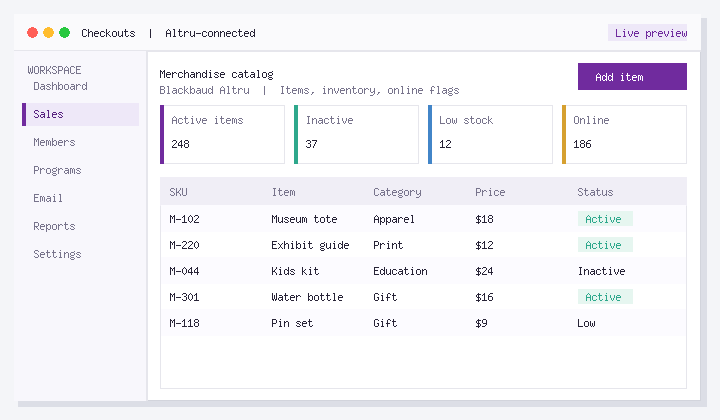
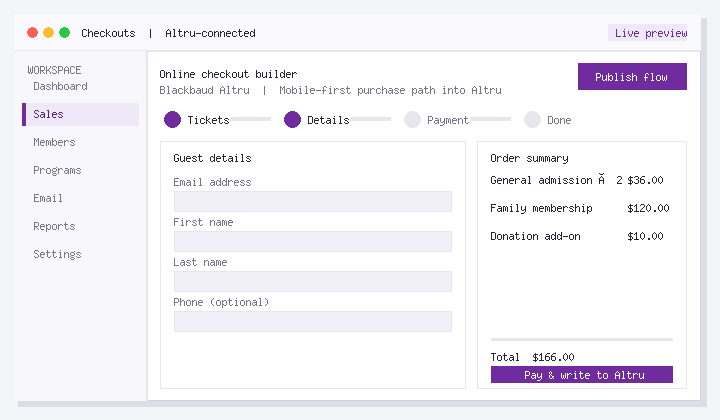
- Checkouts for on-brand mobile ticket and membership sales into Altru
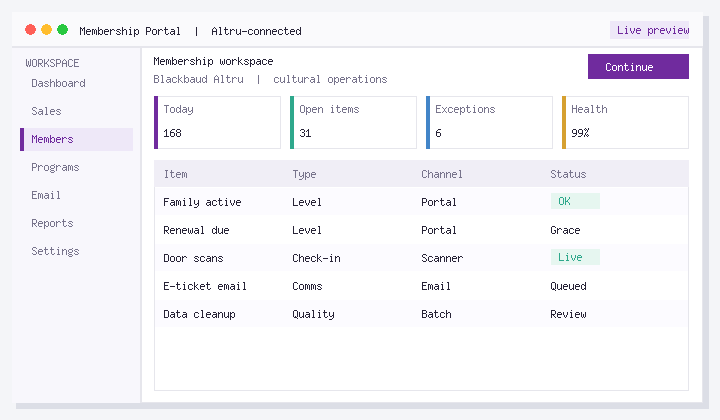
- Membership Portal for member self-service
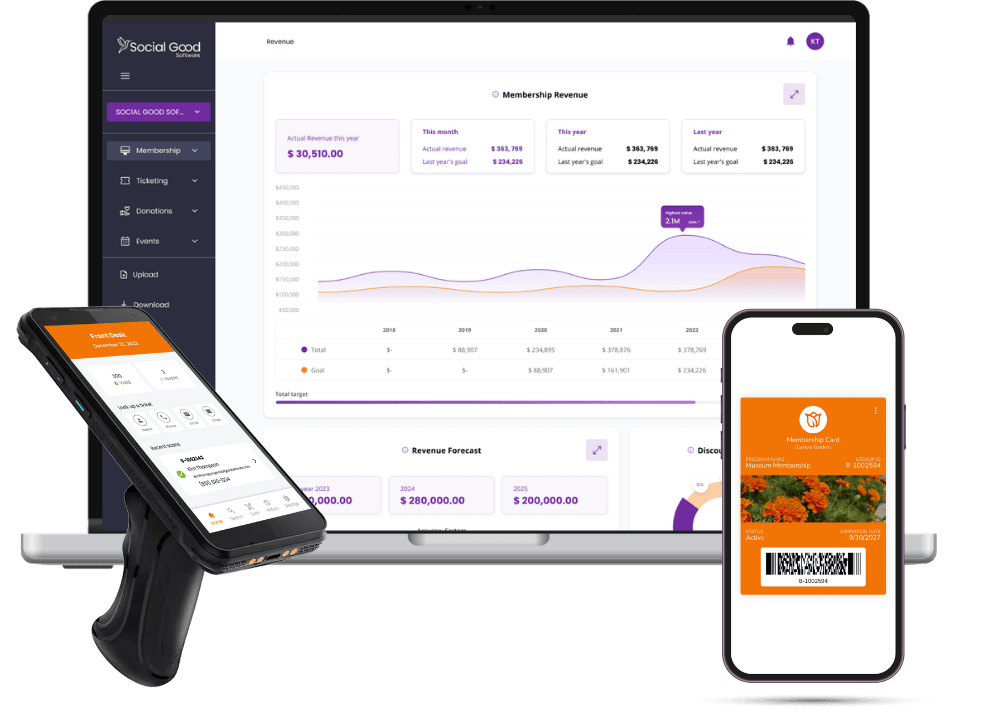
- Digital Membership Cards for wallet-ready credentials tied to Altru
- Ticket Scanner for Altru ticket and membership barcode check-in
- Email Designer for automated Altru-connected email
- Data Bridge and Deduper for Altru-centric sync and duplicate management
If your project is “connect and clean data across multiple nonprofit systems,” Omatic is often the right category. If your project is “make Altru sell better, serve members better, and run guest services faster,” Social Good Software is usually the cleaner answer.
When Omatic is a strong fit
Teams often evaluate Omatic when they need:
- Cross-system integration as the main outcome. Data must flow reliably between Altru (or another Blackbaud product), email platforms, fundraising tools, finance systems, and other applications.
- Enterprise-grade import and transform rules. Complex mapping, reusable profiles, automated workflows, and ongoing data pipelines are core to the purchase.
- Duplicate prevention at the integration layer. Identifying and preventing duplicate constituents during import and sync is a primary requirement, especially for multi-system nonprofits.
- A multi-CRM or multi-product Blackbaud environment. Organizations using Raiser’s Edge NXT, Blackbaud CRM, Salesforce, and Altru in combination often need middleware that understands nonprofit data models.
- Data health as its own program. The initiative is owned by database, advancement services, or IT teams whose KPI is clean, complete, connected data rather than timed-entry conversion or door speed.
If those are the primary problems you are buying software to solve, Omatic deserves a serious evaluation with your real source systems and duplicate scenarios on the table.
When Social Good Software is the right solution
Choose Social Good Software when the real constraints look like this:
- Altru is the center of daily operations. Ticketing, memberships, programs, queries, and acknowledgments already live in Altru. You need better guest and member experiences around that system, not only better pipes between systems.
- Revenue and frontline workflows are the bottleneck. Timed-entry calendars, branded mobile checkout, membership self-service, digital cards, door scanning, and automated email are the jobs to be done.
- Data tools should support those workflows, not replace the product strategy. Deduper and Data Bridge matter, and they sit inside a broader Altru operations suite rather than as a standalone integration platform.
- You want fewer vendors for the Altru front door. One partner covering calendars, sales UX, membership, cards, scanning, email, and Altru-centric data quality can be simpler than stitching a commerce stack to a separate middleware stack.
- Staff time is measured in guest services and membership hours, not only import jobs. The pain is Saturday door lines, renewal exceptions, printed cards, and weak web conversion as much as nightly file loads.
In short: Omatic often fits data-integration and data-health evaluations. Social Good Software fits Altru operations and revenue evaluations.
Side-by-side comparison
| Decision factor | Omatic | Social Good Software |
|---|---|---|
| Primary focus | Nonprofit data integration, imports, mapping, and duplicate prevention | Altru operations and revenue: calendars, checkouts, membership, cards, scanning, email, data |
| Core buyer | Database, advancement services, IT, multi-system integration owners | Guest services, membership, web, and Altru operations leaders |
| Relationship to Altru | Integrates with Altru as one of several nonprofit systems | Deep specialization with Altru as system of record for day-to-day ops |
| Best for | Connecting and cleaning data across Blackbaud and other nonprofit apps | Improving Altru ticket sales, memberships, door workflows, and automation |
| Timed ticketing website calendars | Not the product category | Core product: Calendar Builder |
| On-brand online checkout | Not the product category | Core product: Checkouts into Altru |
| Digital membership cards | Not the product category | Digital Membership Cards connected to Altru |
| Door scanning | Not the product category | Ticket Scanner for Altru tickets and membership barcodes |
| Member self-service | Not the product category | Membership Portal for Altru membership workflows |
| Email automation from Altru queries | Integrations that can support email systems as connected apps | Email Designer built for Altru-connected automated email programs |
| Duplicate management | Core strength: identify and prevent duplicates in integration workflows | Deduper for Altru-centric duplicate and merge workflows |
| Cross-system data pipelines | Core strength: Omatic Cloud connectors, mapping, and automation | Data Bridge and focused Altru sync tools, not a full iPaaS suite |
| Multi-CRM / multi-Blackbaud stacks | Strong fit across RE NXT, BBCRM, Salesforce, Altru, and more | Optimized for Altru-centered cultural organizations |
This is not a scorecard where one product always wins. It is a map of different purchase decisions. Some large organizations may eventually need both categories: middleware for enterprise data movement, and Altru-native tools for guest-facing revenue operations.
Data quality vs guest revenue: both matter, different owners
Clean data and better guest experiences are related, but they are not the same software project.
Data integration projects usually start with questions like:
- Which systems are sources of truth for gifts, members, tickets, and email preferences?
- How do we prevent duplicates when records enter from multiple channels?
- How do we map and transform fields consistently every night or in near real time?
- How do we connect Blackbaud products to email, finance, and other nonprofit apps without brittle spreadsheets?
Altru operations projects usually start with questions like:
- Why is timed ticketing hard to present on the website?
- Why does mobile checkout convert poorly or feel off-brand?
- Why do members call us for updates they should complete themselves?
- Why do printed cards and resends consume staff time?
- Why are acknowledgment and reminder emails brittle?
- Why do door lines grow when scanning is slow?
Omatic is built around the first list. Social Good Software is built around the second list, with Altru-centric data tools included so the suite can support clean membership and marketing workflows without becoming a general-purpose integration platform.
Where Social Good Software is especially strong for Altru teams
Cultural organizations on Altru rarely struggle with only one surface. The same week can include weak web conversion, membership exceptions, credential fulfillment, email automation, and door pressure. Social Good Software is designed so those problems can be addressed as a connected Altru suite:
- Calendar Builder for timed entry presentation
- Checkouts for on-brand purchase flows into Altru
- Membership Portal for self-service
- Digital Membership Cards for modern credentials
- Ticket Scanner for guest services throughput
- Email Designer for Altru-connected automation
- Data Bridge and Deduper for sync and duplicate work tied to those operations
If your roadmap is primarily “integrate everything,” start with a data platform category. If your roadmap is primarily “make Altru work better for guests and staff this season,” start with Social Good Software.
Can Omatic and Social Good Software coexist?
Yes, in principle, because they target different layers. A team might use Social Good Software for calendars, checkouts, cards, scanning, and Altru email automation, while using a dedicated integration platform for broader multi-system data movement. Before combining vendors, map ownership clearly:
- Which system creates the member or ticket sale?
- Which system is allowed to update households and emails?
- Where are duplicates resolved?
- Who supports exceptions on peak days?
Two systems writing the same constituent fields without rules creates support burden. Architecture matters more than logo count.
How to choose in a one-hour evaluation
- Name the primary outcome. Clean multi-system data, or better Altru sales and guest operations?
- Identify the system of record for the next three to five years. If Altru is central for tickets and memberships, weight Altru-native depth highly for revenue tools.
- Rank the top three pain points. Imports and duplicates, or calendars, checkout, portal, cards, scanning, and automation?
- Map the budget owner. IT and database teams often buy integration platforms. Membership and guest services leaders often buy Altru operations tools.
- Require a scenario demo. For Omatic, bring real source files and duplicate cases. For Social Good Software, bring real programs, membership levels, and peak-day workflows.
- Price total ownership. Include implementation, ongoing admin time, and the cost of keeping Altru truthful if multiple systems write overlapping data.
- Decide whether you need one category or two. Do not force a data platform to solve timed-entry UX, and do not force a revenue suite to replace enterprise middleware.
FAQ
Is Social Good Software an Omatic alternative?
Only for a narrow slice of needs, such as Altru-centric duplicate management or selected sync workflows. It is more accurate to call Social Good Software an Altru operations and revenue suite, while Omatic is a nonprofit data integration and data health platform.
Does Social Good Software replace Blackbaud Altru?
No. Altru remains the system of record. We extend the experiences around it so teams can move faster without leaving Altru behind.
Does Omatic replace Altru?
No. Omatic connects and cleans data among systems. It is not a ticketing, membership portal, or website calendar product.
Who is Social Good Software built for?
Museums, science centers, zoos and aquariums, botanical gardens, historic sites, and cultural nonprofits running Blackbaud Altru that want modern guest and member experiences, plus practical Altru data tools, without standing up a full integration platform as the main project.
How should we evaluate both vendors?
Score each against the job you are actually buying. For data integration, test mapping, duplicates, error handling, and multi-system scenarios. For Altru operations, test timed ticket purchase on mobile, membership renewal, digital credentials, door scanning, and automated email. Use the same success criteria your staff will live with on a peak Saturday.
Next steps
If your organization runs Altru and you want to improve calendars, checkout, membership, digital cards, scanning, email automation, and Altru-centric data quality as one connected suite, start here:
- Watch product explainers on the software demos hub
- Review the features suite and pricing
- Book a one-on-one demo with your programs and membership structure
The best software decision is the one that matches the work your team actually does, whether that work is nightly data integrity or Saturday door volume.
About Social Good Software: We help cultural organizations on Blackbaud Altru increase ticket sales and memberships, save staff time, and move the mission forward with modern calendars, checkouts, membership tools, digital cards, scanning, email automation, and data quality, purpose-built around Altru.
Note: Product capabilities change over time. This article reflects Social Good Software’s publicly documented product focus and publicly available positioning for Omatic as a nonprofit data integration category. Always confirm current features, integrations, and pricing directly with each vendor.